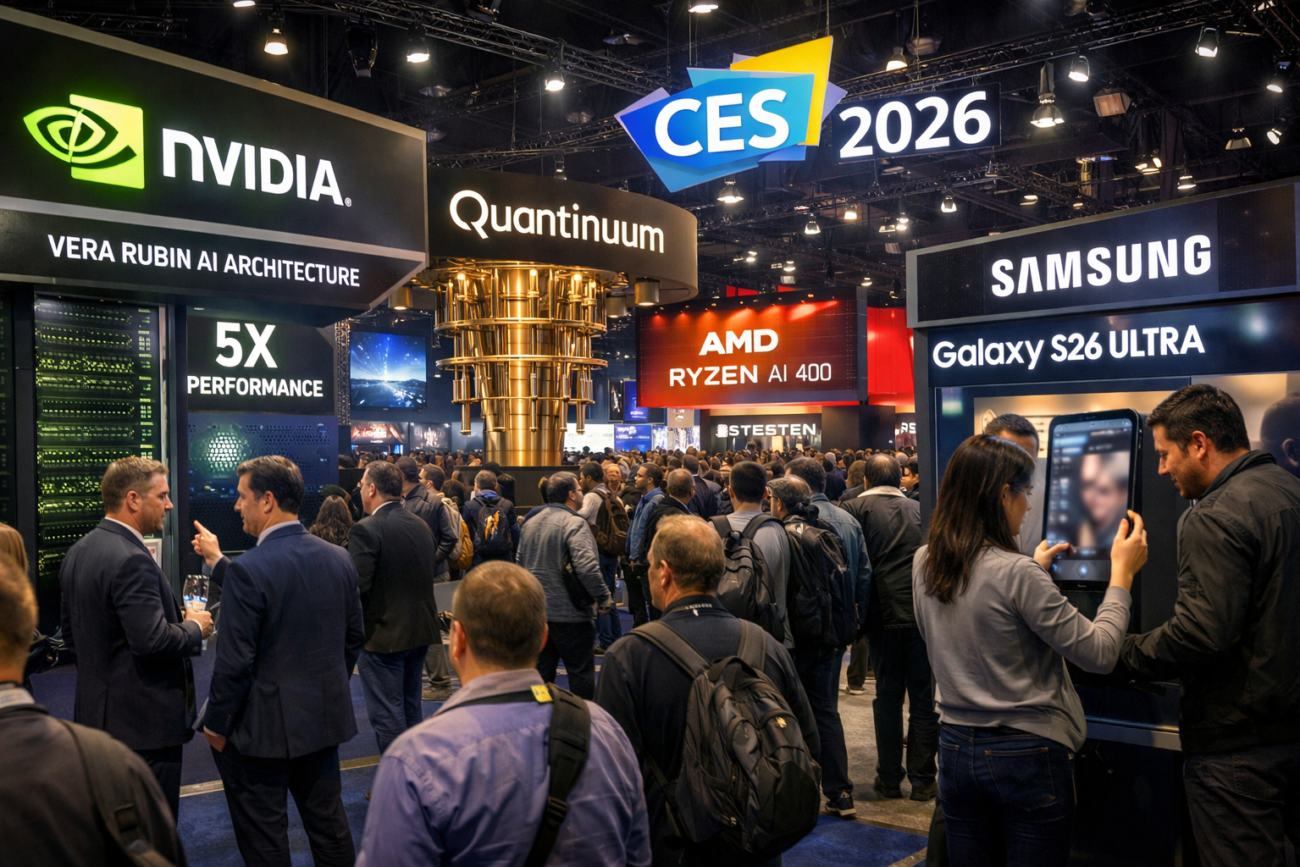
CES 2026 showcased groundbreaking advancements in AI inference, quantum computing, and privacy tech, signaling a shift toward practical, scalable AI deployment. Nvidia’s massive investments and Samsung’s innovative displays highlighted how inference—the process of running trained AI models—is becoming the next battleground for tech dominance. These developments address real-world challenges like energy efficiency and data security in an era of exploding AI demand.
January kicked off with CES in Las Vegas dominating headlines, where quantum and semiconductor innovations stole the spotlight. Quantinuum unveiled systems enhancing generative AI through quantum-generated data, partnering with Nvidia’s AI accelerators for breakthroughs in data analysis and material design. NVIDIA pushed forward with its Vera Rubin architecture, promising 5X performance gains in AI platforms, while AMD accelerated AI roadmaps for PCs with higher-NPU processors like Ryzen AI 400. These announcements underscore a convergence of hardware and software tailored for AI-first environments.
Nvidia’s strategic moves extended beyond hardware, with a pivotal $150 million investment in AI inference startup Baseten. The funding round raised $300 million total, doubling Baseten’s valuation to over $5 billion, led by IVP and Alphabet’s CapitalG. This positions inference as the critical next phase after model training, focusing on efficient deployment at scale amid surging demand for real-time AI applications.
Samsung countered with the Galaxy S26 Ultra’s Privacy Display, accidentally confirmed via a One UI 8.5 leak on January 22. The feature uses on-device AI to automatically blur sensitive content when bystanders approach, mimicking privacy screen protectors but with smart toggle controls. Users can customize it for apps like banking or enable contextual activation in public spaces, blending convenience with proactive security.
Challenges persist, including Microsoft’s response to AI data center protests over grid strain, pledging to cover power costs without tax breaks. Quantum tech faces scalability hurdles, though IBM and AMD explore hybrid architectures integrating quantum with CPUs, GPUs, and AI. Waymo’s robotaxis encountered setbacks from a San Francisco outage, raising questions about resilience in emergencies.
Looking ahead, these trends point to 2026 as the year AI moves from labs to everyday infrastructure. Folding devices like rumored Apple phones and AI hardware from OpenAI-backed startups could mainstream new form factors. With data centers globalizing and robots gaining intelligence, tech’s focus on sustainability and ethics will shape adoption. India’s Digital India initiatives stand to benefit, accelerating skill development in AI and quantum fields.
