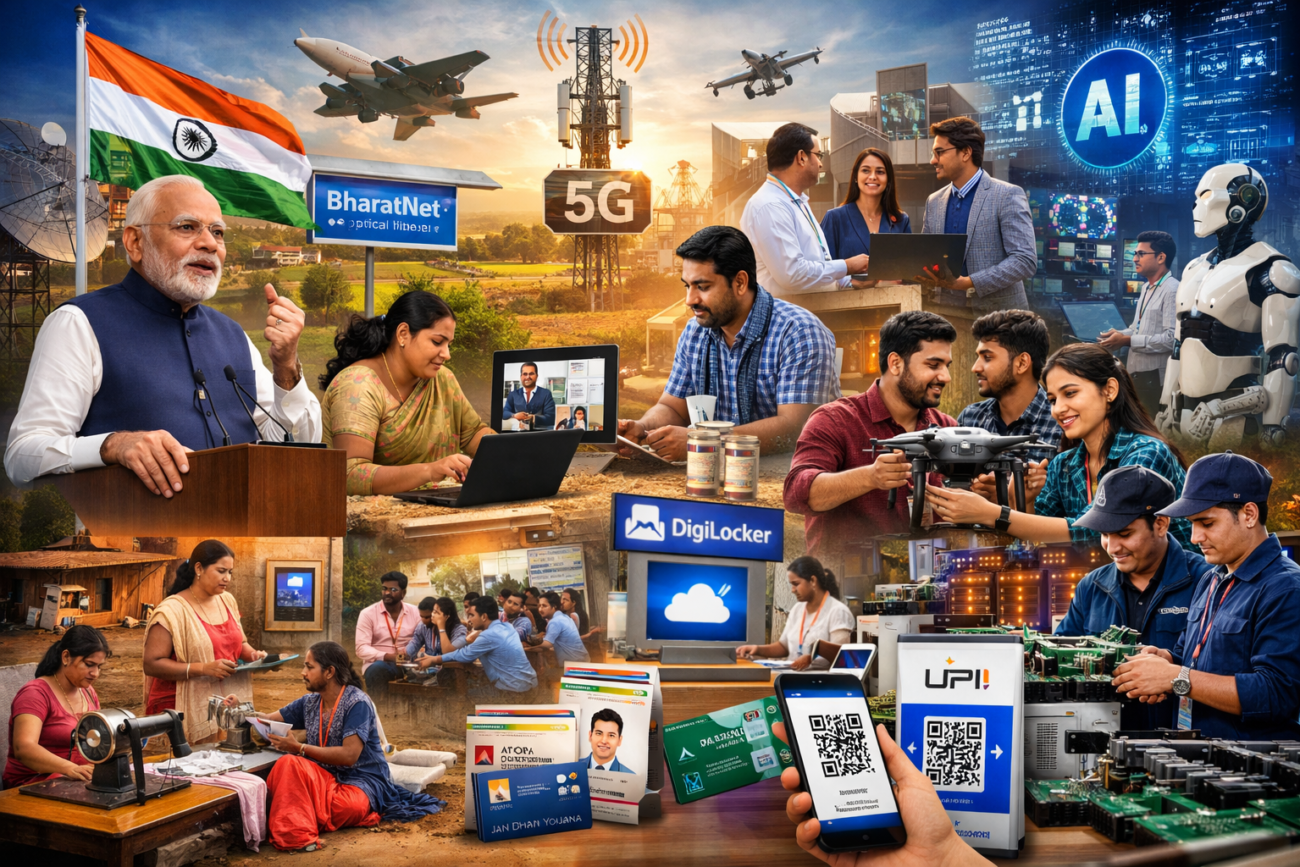
Digital India, marking its 11th year since launch on July 1, 2015, evolves into a people-centric movement democratizing technology and bridging rural-urban divides through robust digital infrastructure. BharatNet connects over 6.29 lakh villages with optical fiber spanning 42 lakh km, while 5G base stations exceed 4.81 lakh for high-speed access even in border areas. Aadhaar’s universal digital ID enables secure service delivery, powering JAM Trinity for leak-proof direct benefit transfers to millions.
Governance on demand thrives via UMANG, DigiLocker, and MyGov, digitizing passport applications, tax filings, and utility payments to slash delays and corruption. PM eVidya and PMGDISHA drive e-learning in regional languages, with digital literacy reaching millions amid 67% internet penetration (up 26.6% year-over-year). Telemedicine and e-hospital platforms extend healthcare to remote regions via ABHA digital health IDs.
Financial inclusion soars with UPI processing billions of monthly transactions, integrating informal workers into the formal economy through Jan Dhan accounts. Public Wi-Fi hotspots hit 3.73 lakh, advancing toward 50 million by 2030 despite gaps from earlier targets. Domestic electronics manufacturing gains via nine pillar programs, fostering Atmanirbhar Bharat in AI, blockchain, and IoT.
Budget 2025-26 allocates ₹500 crore for AI Centre of Excellence in education and funds 50,000 Atal Tinkering Labs by 2031, with ₹14,903 crore expansion plan digitizing the economy. Digital India Corporation innovates e-governance solutions, supporting cybersecurity and responsible AI amid DPDPA enforcement. India Digital Summit 2026 convenes leaders to shape tech-driven growth.
PM Modi highlights Digital India’s role in Viksit Bharat at National Youth Day 2026, synergizing with Startup India for 1,000+ defense innovators in drones and AI surveillance. Intelligent infrastructure integrates edge computing for video surveillance markets eyeing $7 billion by 2030. These strides position India as a global digital leader, empowering citizens for knowledge economy participation.
