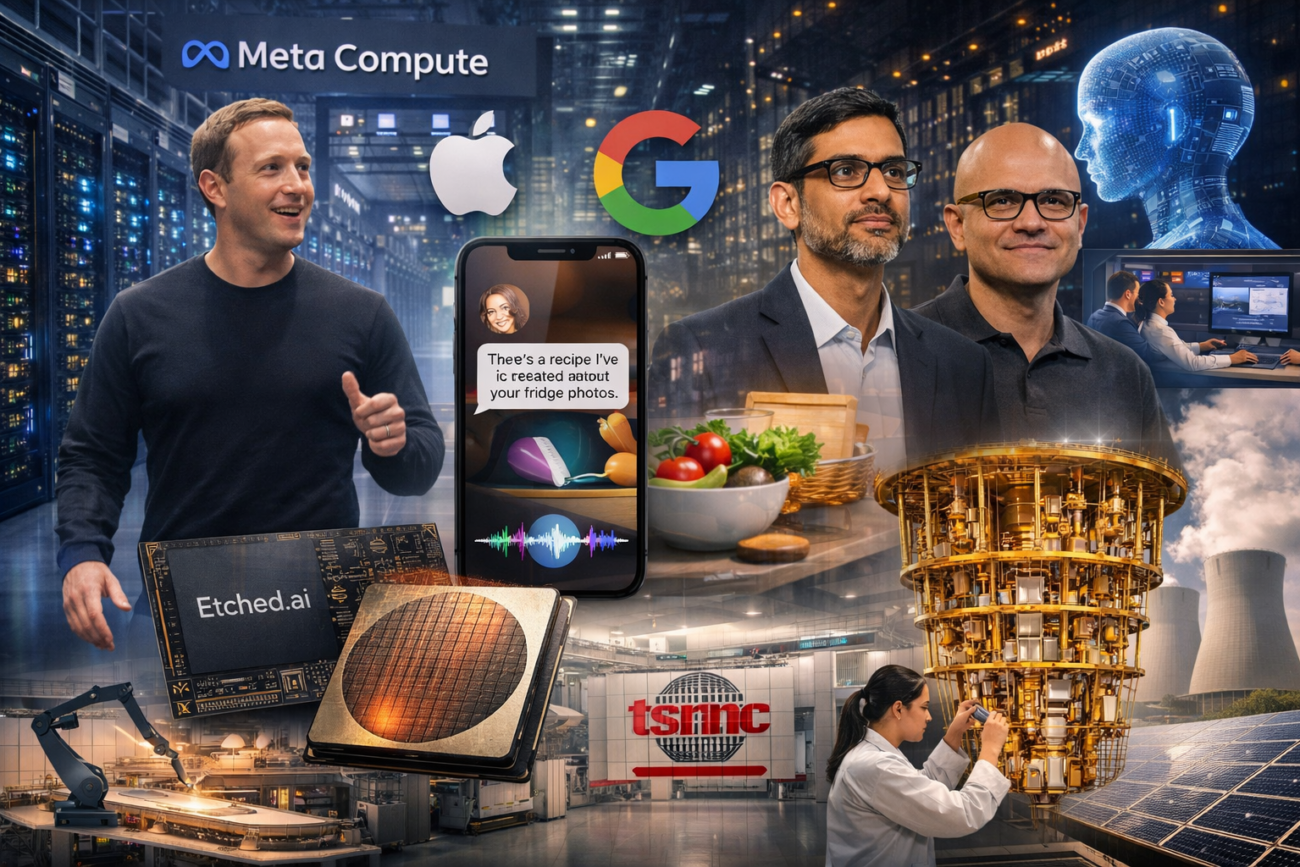
Meta launched “Meta Compute,” a dedicated division to consolidate its data centers, networking, and AI hardware efforts into a unified powerhouse. CEO Mark Zuckerberg announced plans to scale up to tens of gigawatts of compute capacity this decade, tackling the massive energy demands of training next-generation AI models. This move positions Meta to compete directly with rivals like Google and Microsoft in the hyperscale AI arena.
AI chip startups are attracting blockbuster investments to erode Nvidia’s market lead. Etched.ai secured $500 million at a $5 billion-plus valuation, focusing on custom ASICs tailored for Transformer-based AI inference, promising up to 10x efficiency gains over GPUs. Cerebras Systems, meanwhile, is in talks for $1 billion in funding and a landmark OpenAI partnership deploying 750MW of its wafer-scale engines for ultra-fast inference.
Apple’s partnership with Google brings Gemini AI to Siri, marking a pivotal upgrade for iOS users. The integration will enable advanced features like contextual conversations, real-time world knowledge, personalized reminders, and creative tasks such as generating recipes from fridge photos. Rollout is slated for iOS 20 in fall 2026, blending on-device processing with cloud smarts.
These developments underscore a broader shift where AI success hinges on infrastructure over algorithms alone. Voice AI firm Deepgram’s $130 million Series C at $1.3 billion valuation highlights enterprise demand for real-time transcription in calls and meetings. Investors poured billions into hardware amid predictions of explosive growth.
Global supply chains are ramping up accordingly. TSMC forecasted $56 billion in 2026 capital spending, a 37% jump, to fabricate cutting-edge AI chips at 2nm and beyond. Quantum computing edges forward too, with Haiqu raising $11 million for software optimizing noisy intermediate-scale quantum hardware.
Power constraints loom large, prompting tech giants to ink deals with nuclear innovators like Oklo and grid operators such as Vistra. Analysts forecast this infrastructure frenzy will unlock trillion-parameter models and agentic AI by year’s end.
India’s tech ecosystem watches closely, with startups like Sarvam AI eyeing similar chip deals to fuel vernacular language models. As 2026 unfolds, the race for compute supremacy promises to reshape global innovation landscapes.
